.png&w=96&q=75)

CoSupport AI 2.0: Agentic AI in Customer Service - What Changes When AI Can Actually Do Things
There's a difference between an AI that tells a customer "here's how to cancel your subscription" and an AI that cancels the subscription. Both give the customer an answer. One still requires the customer to go do something. The other resolves the issue completely - no follow-up, no click path, no risk of the customer getting stuck halfway through.
That distinction is the practical line between conversational AI and agentic AI. This article explains what agentic AI means in a customer support automation context, what it can and can't do, and why the shift matters for support teams.
What Makes AI "Agentic"
Conversational AI generates text. It reads a question and writes an answer. The answer might be perfect - accurate, empathetic, on-brand - but acting on it is still on the customer or a human agent. Agentic AI executes. It reads the question, determines what needs to happen, calls the relevant system (your helpdesk, your CRM, your payment processor), performs the action, and confirms completion - all within the same interaction.
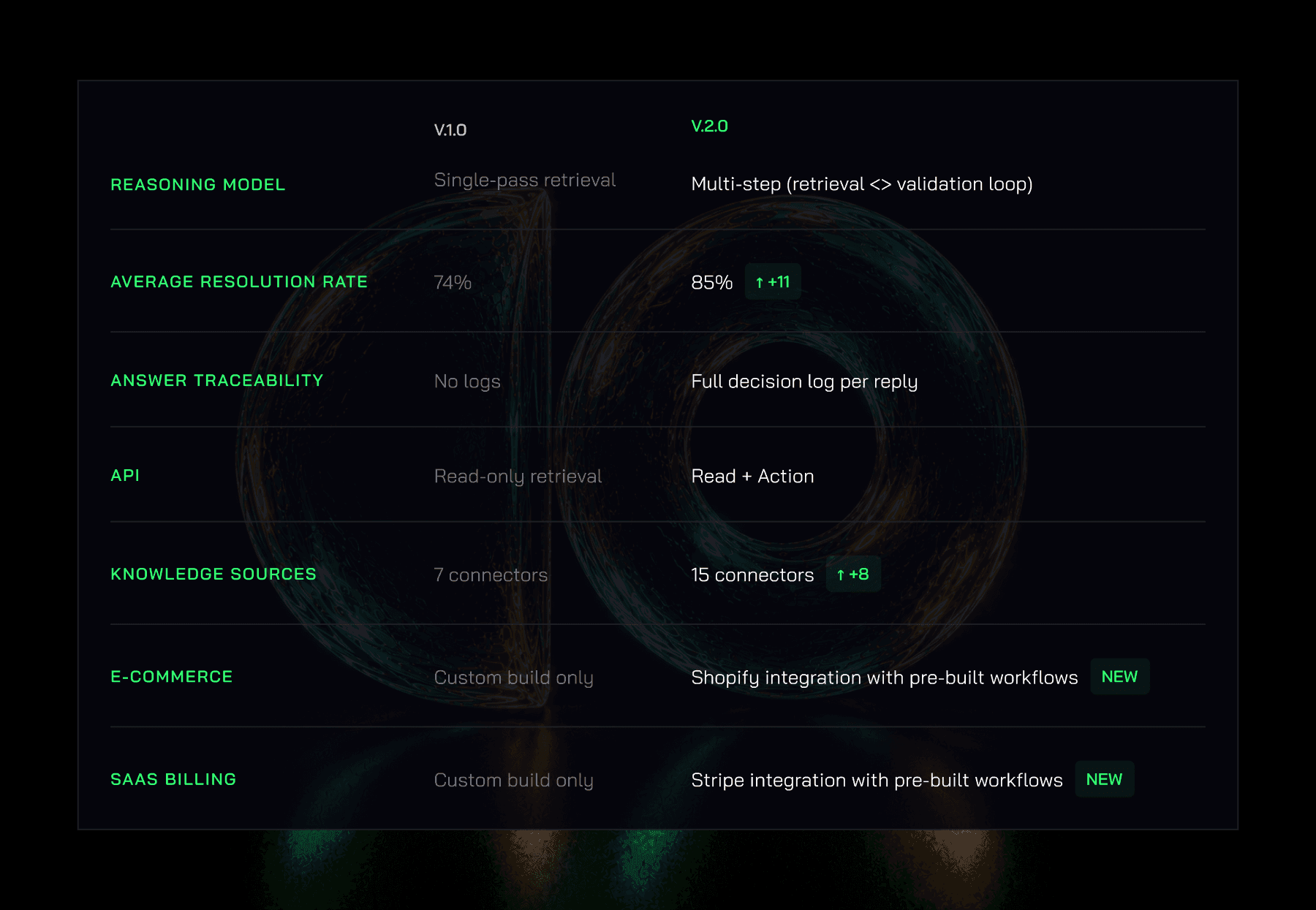
The technical enabler is an action layer: an API that connects AI reasoning to the operational systems your business actually runs on. Without that layer, AI stays in the conversation. With it, AI reaches into your stack. CoSupport AI 2.0 introduced the Agentic API to do exactly this.
What Agentic AI Can Do in Support
In a customer support context, agentic AI handles the class of tickets where the answer isn't a piece of information - it's an action.
- Subscription management. A customer wants to cancel, downgrade, or pause their plan. Rather than pointing them to account settings, the AI Agent processes the request directly via your billing integration, confirms the change, and closes the ticket.
- Order management. "Where is my order?" isn't just a lookup question for e-commerce teams. A customer whose order is delayed may want a reship, a refund, or an exchange. Agentic AI initiates those workflows inside Shopify without a human agent touching the ticket.
- Account-specific information retrieval. Some questions can't be answered from static knowledge base content - they require pulling live account data. "Am I still under warranty?" "Did my payment go through?" Agentic AI queries the relevant system and builds the answer from real data, not a generic FAQ.
- Escalation with context. When a ticket genuinely needs a human, agentic AI doesn't just transfer it. It collects all relevant context first - order number, account details, issue history. The agent who picks it up doesn't need to ask the customer to repeat themselves. At that point, the AI Assistant takes over, drafting replies and surfacing relevant documentation for the human agent.
What Agentic AI Can't Replace
Agentic AI is not the right tool for every ticket. Complex billing disputes with multiple conflicting claims, situations requiring legal or compliance judgment, or interactions where the customer is emotionally distressed - these still need a human.
The practical breakdown: agentic AI handles L1 tickets that require action (roughly 40-60% of total support volume, depending on your business model). Human agents handle L2 and L3 - complex cases where the correct action isn't clear from the data alone.
What agentic AI changes is the scope of what counts as L1. Previously, L1 meant simple informational questions. With an agentic layer, L1 now includes a large share of transactional requests that were previously routed to agents simply because no tool could handle them end-to-end.
The Integration Requirement
Agentic AI is only as capable as the integrations behind it. An AI agent connected only to your knowledge base can generate good answers. An AI agent connected to your helpdesk, your Shopify store, and your billing system can close tickets autonomously.
This is why integration depth matters more in agentic AI than in conversational AI. The quality ceiling for a conversational AI is the quality of your documentation. The quality ceiling for an agentic AI is the quality of your connected systems.
CoSupport AI 2.0 ships an Agentic API that connects to Shopify, Stripe, Zendesk, Freshdesk, HubSpot, Pylon, and a growing list of other platforms. Every new account gets this infrastructure by default.

The Practical Outcome
When a support team moves from conversational to agentic AI, what changes isn't just the deflection rate - it's the type of tickets that get deflected. Conversational AI deflects information requests. Agentic AI deflects action requests.
That's a meaningful shift. Support agents at companies using agentic AI stop spending time on subscription cancellations, order status updates, and refund initiations. Not because customers aren't asking for those things. Because AI is completing them. What's left for the support team is the work that actually needs human judgment: edge cases, account investigations, the complex situations where empathy matters more than process speed.
That's a better use of a support team's time. That's what agentic AI is designed to enable.
Let's pilot together.
.png)

.png&w=96&q=100)



.png&w=96&q=100)